Nature, generation, and dissipation of Alfvénic kinks/switchbacks
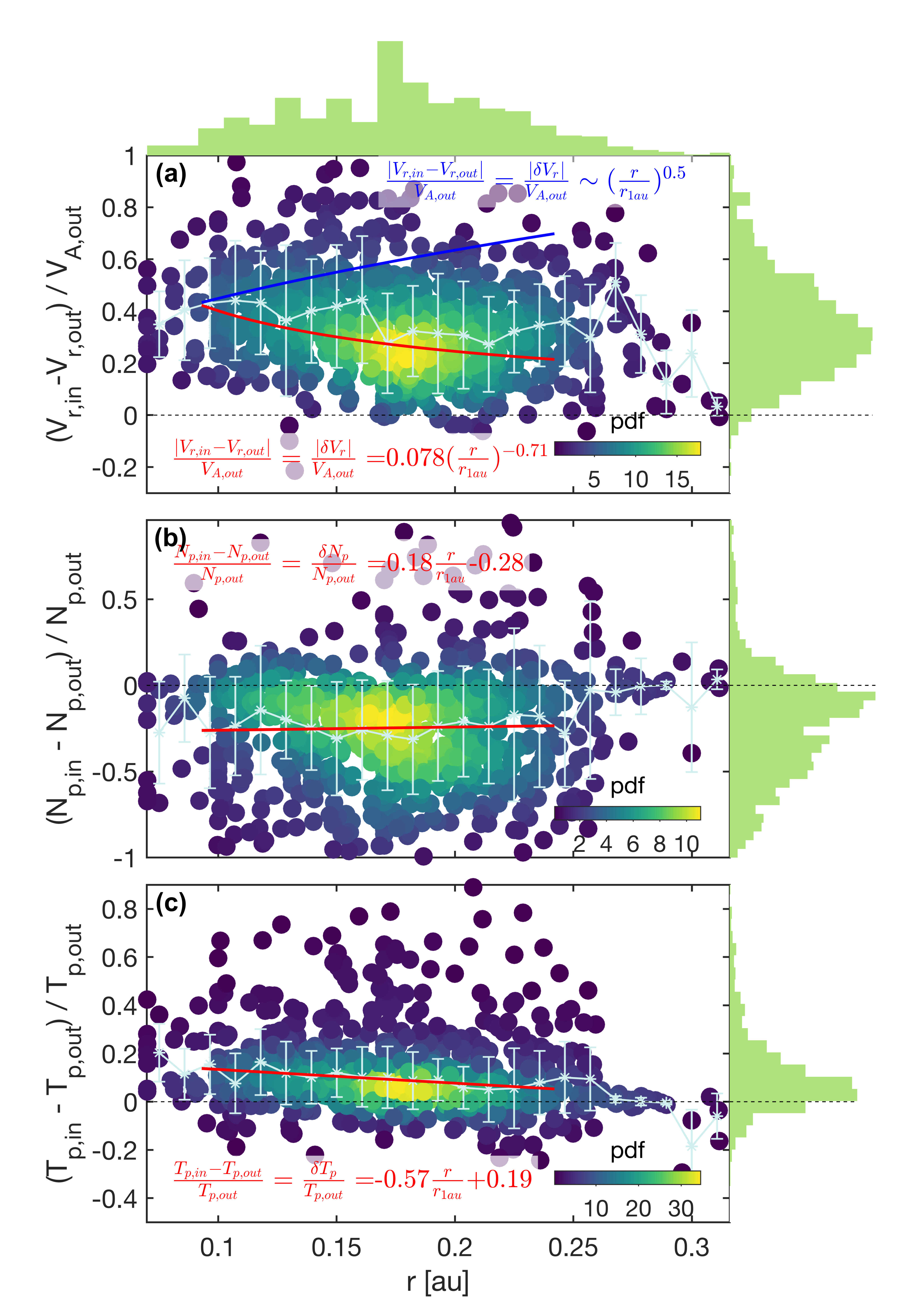
The discovery of very important rich magnetic kinks/switchbacks within 0.3 au has become a scientific highlight of the Parker Solar Probe (PSP) mission. This discovery points at the promising impact of small-scale solar activity on the inner heliosphere. To address the nature, generation, and dissipation of these kinks, we perform a statistical analysis of the plasma and boundary properties of the kinks using PSP multi-encounter observations and Wind measurements at 1 au. The kinks show strong Alfv'enicity and velocity fluctuation of order of Alfv'en speed. These findings suggest that the nature of the kinks is consistent with large amplitude Alfv'en pulses, and the steepening of these Alfv'en pulses is likely to be the formation mechanism of these kinks. Based on the angle between the normal direction of the kink’s boundaries and the background magnetic field vector, PSP-kinks and Wind-kinks can be divided into two groups: quasi-parallel and quasi-perpendicular kinks. We speculate that quasi-parallel kinks form from the coupling of Alfv'en and fast waves as launched from coronal interchange magnetic reconnection. In contrast, quasi-perpendicular kinks may come from the steepening of Alfv'en waves launched from both coronal interchange magnetic reconnection and from the more inhomogeneous solar lower atmosphere. We find that the kink velocity perturbation gradually decreases during outward propagation and is much lower than expected from WKB theory, suggesting a progressive dissipation of the kinks. Comparing PSP-kinks and Wind-kinks, we conjecture that the kinks dissipate through merging with the turbulent energy cascade within 0.25 au.
C. Hou, X. Zhu, R. Zhuo, J. He, D. Verscharen, and D. Duan, “Nature, generation, and dissipation of alfvénic kinks/switchbacks observed by parker solar probe and wind”, The Astrophysical Journal 950, 157 (2023).