Dynamics of the Charged Particles Released from a Sun-grazing Comet in the Solar Corona
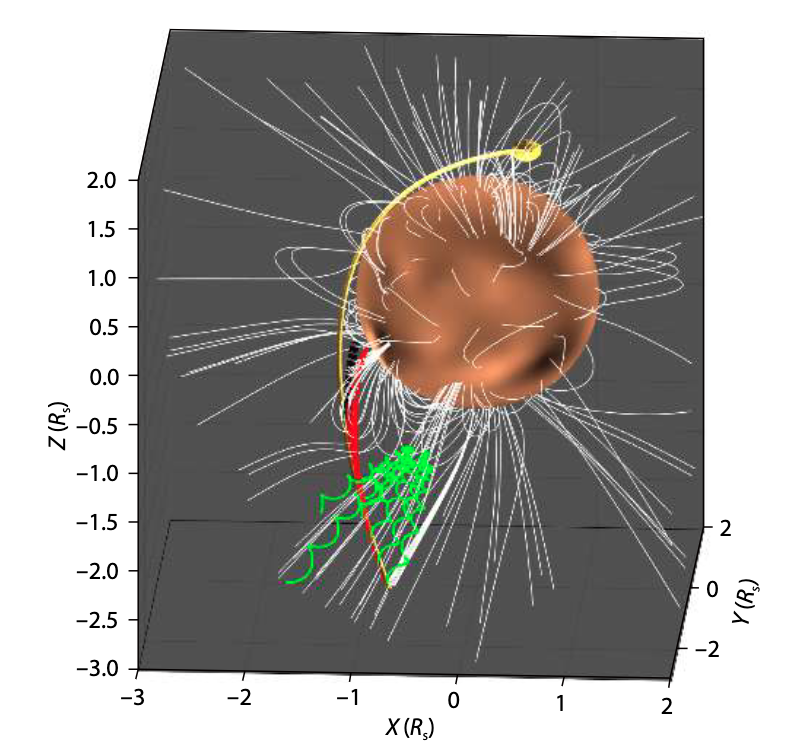
The sun-grazing comet C/2011 W3 (Lovejoy) showed a distorted, unconventional tail morphology near its perihelion (1.2Rs).Based on the “Solar Corona and Inner Heliosphere” modeling result of the magnetic field and plasma dynamics in the solar corona, weuse the Runge-Kutta method to simulate the moving trajectory of charged dust and ion particles released at different positions from theC/2011 W3 orbit. We find that the dust particles near the sun, which are subject to a strong magnetic Lorentz force, travel differently fromtheir counterparts distant from the sun, where the latter are mainly affected by the solar gravitational force and radiation pressure.According to the simulation results, we propose that the magnetic mirror effect can rebound the charged dust particles back away fromthe sun and be regarded as one crucial cause of the dust-free zone formation. We find that ions mainly move along magnetic field lines atan acute angle to the comet’s direction of motion. The cometary ions’ movement direction was determined by the comet’s velocity andthe coronal magnetic field, which are responsible for the C/2011 W3’s unique comet tail shape near perihelion. Additionally, the ionparticles also experience perpendicular drift motion, mainly dominated by the electric field drift, which is similar to and can be used toapproximate the solar wind’s transverse velocity at its source region.
C. Hou, J. He, L. Zhang, Y. Wang, and D. Duan, “Dynamics of the charged particles released from a sun-grazing comet in the solar corona”, Earth and Planetary Physics 5, 232–238 (2021).